
The Gift & Grief in Self-Doubt
Published: Invalid Date
Hi lovely friends,
The Gift & Grief in Self-Doubt
Lately, an unwelcome guest has taken up residence in my mind: self-doubt.
As a student, practitioner, and mother of six for nearly 30 years, I imagined I would feel sturdier by now. Yet even decades of lived experience can still be shaken.
Right now, midlife hormonal shifts, world events, the financial pressures facing my adult children, and the beautiful exhaustion of living in a multigenerational home have left me quietly wrestling with a painful question:
If they’re still struggling, does it mean I’m failing?
I find myself second-guessing decisions I once made with far more ease. I want to avoid conflict and criticism, yet I also want to protect my boundaries, honour my values, and stay true to myself.
Sometimes I feel caught in the middle.
And perhaps surprisingly, I do not think self-doubt is always a bad thing.
Self-Doubt as a Protective System
Self-doubt felt like a familiar and unwelcome guest in my mind.
I hid from her and blamed her for making me feel small and miserable.
But, I finally poured her a cup of tea and listened.
It turns out, this uncomfortable visitor isn’t just a bummer, she is also a blazer for growth.
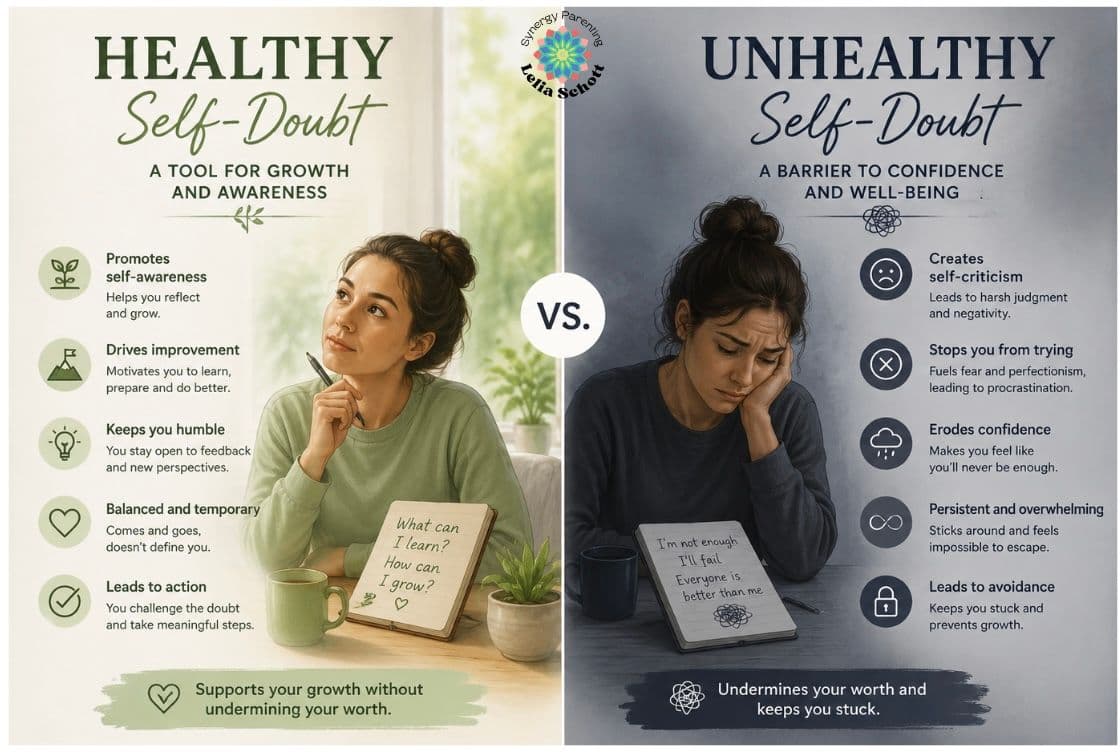
Here are the pros and cons of inviting self-doubt to the table:
From an evolutionary psychology perspective, self-doubt is part of the brain’s protective system. Its role is to make us pause, assess risk, and think carefully before acting. Our ancestors who never questioned themselves were often the ones who took reckless risks without caution. They didn't double-check the bushes or question if a new path was safe; they just leaped. And frankly, they didn't survive long enough to pass on their genes. We are the descendants of the cautious ones. We inherited the brains that worry, analyse, and second-guess because, once upon a time, that worry kept us alive.
In this way, self-doubt became an internal speed bump — a mechanism designed to slow us down long enough to reflect before leaping.
And in parenting, that can become both an asset and an obstacle.
Healthy Self-Doubt
At its healthiest, self-doubt reflects empathy. Worrying about whether we are doing a good job often reveals how deeply we care about our children’s well-being.
Healthy self-doubt can:
• Keep us humble and teachable
• Encourage reflection and repair
• Help us notice blind spots
• Push us toward healthier tools and patterns
• Prevent rigid certainty and overconfidence
• Remind us that parenting is something we grow into, not something we master perfectly
In many ways, thoughtful self-doubt can make us gentler parents because it keeps our hearts open.
When Self-Doubt Becomes Harmful
But self-doubt becomes harmful when it stops being reflective and becomes relentlessly critical.
When the inner voice no longer says:
“Pause and reflect.”
But instead says:
“You are failing.”
“You are not enough.”
“You will ruin everything.”
At that point, self-doubt stops protecting us and starts exhausting us.
- It clouds decision-making.
- It creates analysis paralysis.
- It fuels shame.
- It drains emotional energy.
- And it can make even ordinary parenting moments feel unbearably heavy.
Perhaps this is why so many parents feel quietly overwhelmed:
Because parenting asks us to hold enormous responsibility while accepting that we will still make mistakes.
No parent gets through this without causing pain at times.
Not because we do not love deeply enough,
but because we are human beings raising human beings.
Learning to Listen Without Being Ruled by Doubt
The goal is not to become a parent who never doubts themselves.
The goal is to become a parent who can listen to doubt without being ruled by it.
To let self-doubt invite reflection without letting it become self-condemnation.
To stay open to growth without abandoning ourselves in the process.
Perhaps healthy self-doubt, in its gentlest form, is not evidence that we are failing.
Perhaps it is evidence that we care deeply.
Maybe part of my struggle has been avoiding a painful truth:
That even my strongest efforts still resulted in mistakes.
And that feels sad.
Disappointing.
Exhausting.
Frustrating.
There is grief in realizing that love does not make us flawless.
That insight, effort, devotion, and repair still do not protect our children — or ourselves — from every wound.
But when we add self-compassion, hope, and grace to the mix, something softens.
Self-doubt no longer becomes proof that we are failing, it becomes a guiding light.
A quiet reminder that we may need more safety, support, rest, reflection, or repair.
And perhaps also a reminder that it is okay to be imperfect people raising imperfect people.
With love,
♡𝓛𝓮𝓵𝓲𝓪